Alliance of Schools for Cooperative Insurance Programs

ascip

  • COVID-19
    • Reopening Schools Planner
  • About
    • Calendar
    • Financial Strength
    • Governance
    • Members
    • News & Updates
    • FAQ’s
  • Insurance for Schools
    • Coverages
    • Property & Liability
    • Workers’ Compensation
    • Health Benefits
    • OCIP – Construction Insurance for Schools
    • Request A Quote
  • Risk Services
    • Member Shared Resources
    • Risk Management Prevention Services
    • Guidelines & Best Practices
    • Sample Agreements & Forms
    • Abuse Prevention Resources
    • Special Education Resources
    • Risk Alerts & Bulletins
    • Lessons Learned – Sharing Experiences
    • Safety Spotlight Resources
    • Additional Resources and Forms
    • FAQs
  • Training
    • 2022 Virtual Annual Membership Meeting
    • Online Training
    • Seminars & Webinars
    • Resources
  • Forms & Tools
  • Contact
  • COVID-19
    • Reopening Schools Planner
  • About
    • Calendar
    • Financial Strength
    • Governance
    • Members
    • News & Updates
    • FAQ’s
  • Insurance for Schools
    • Coverages
    • Property & Liability
    • Workers’ Compensation
    • Health Benefits
    • OCIP – Construction Insurance for Schools
    • Request A Quote
  • Risk Services
    • Member Shared Resources
    • Risk Management Prevention Services
    • Guidelines & Best Practices
    • Sample Agreements & Forms
    • Abuse Prevention Resources
    • Special Education Resources
    • Risk Alerts & Bulletins
    • Lessons Learned – Sharing Experiences
    • Safety Spotlight Resources
    • Additional Resources and Forms
    • FAQs
  • Training
    • 2022 Virtual Annual Membership Meeting
    • Online Training
    • Seminars & Webinars
    • Resources
  • Forms & Tools
  • Contact

About

Home > About > News & Resources > How to Prevent Multimillion-Dollar Fires
About
  • Financial Strength
  • Governance
    • Archived Agendas
    • Executive Committee
  • Members
  • News & Updates
  • FAQs

How to Prevent Multimillion-Dollar Fires

March 31, 2020
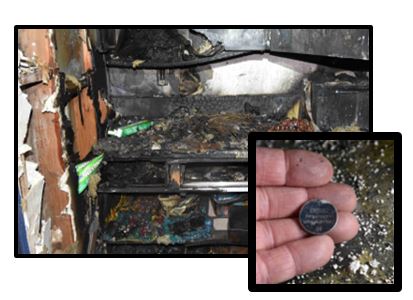
Two ASCIP members recently experienced large multimillion-dollar property loss fires that disrupted education programs.

  1. Lithium batteries caused $1.6 M loss
  2. Space heater caused $8.1 M loss

Members can learn from these fires to mitigate the associated hazards and avoid similar losses.

In the first incident, button lithium batteries had been purchased in bulk by a teacher for an experiment.  Lithium batteries are safe if individually wrapped and no metal to metal contact occurs.  But hundreds of batteries were purchased and apparently left on a counter.  If lithium batteries touch each other, they release heat energy causing a chain reaction.

The Lesson:  When purchasing batteries, members should buy from a reputable manufacturer or supplier; avoid batteries shipped without protective packaging (i.e., hard plastic or equal); inspect them upon receipt and safely dispose damaged ones; store batteries away from combustible materials; if practical, store batteries in a metal storage cabinets and avoid bulk-storage in non-laboratory areas.

The second large property loss occurred when a space heater caught fire, causing more than $8 million in property damages.  A member’s employee had inadvertently left a space heater on during the winter break.  It was their personal heater which had been brought from home.  Space heaters pose a high risk and have a much greater potential for accidental fires.  To avoid experiencing this type of loss, ASCIP recommends members don’t allow space heaters.  However, if allowed, policies and safety protocols should be developed and include:

  • Staff must request permission and pre-register a space heater.
  • Check for recalls at www.saferproducts.gov or www.cpsc.gov.
  • Confirm it is in good working order – three prong plug with ground, cord has no exposed wires and unit is fully enclosed with no external surfaces that reach temperatures capable of starting a fire.
  • It must be U.L. listed and have an automatic shut off if tipped over or left on.
  • Follow operating and maintenance instructions, including, it must be plugged directly into the wall outlet ensuring plug fits tightly into the wall socket.
  • Keep combustible materials at least three feet from all sides of the heater.
  • Heater must be turned off when leaving the room and unplugged at end of day.

Members can reach out to ASCIP for assistance in developing protocols to prevent losses.  We want to help you protect facilities and keep education safe.


Contact Info

Main Office/Southern California Claims Handling:
16550 Bloomfield Avenue
Cerritos, CA 90703

Northern California Claims Handling:
1531 "I" Street, Suite 100
Sacramento, CA 95814

Email: ascip_info@ascip.org
Phone: (562) 404-8029
Fax: (562) 404-8038
Find us on LinkedIn

Useful Links

Email Login CIPA Email
  • CAJPA
  • Cal/OSHA
  • California Laws (Ed, Govt, Insurance, Vehicle Codes, etc.)
  • PARMA
  • PRIMA
  • SELF
  • WeTip
  • ASCIP E-Learning

Join Our Mailing List